Well let me start by apologising for the lack of activity on the blog but all the group members have been too busy on their farms to get started with it! Having returned home from uni and travelling 2 years ago to work full time on our dairy farm (Shaw Farm) I have sadly reached the conclusion there is no such thing as a quiet spell on any farm, hence me sat in bed writing this at 11pm after having just finished the last of our first cut of silage.
Silage, and please let me just clear up this point, has nothing in common with either slurry or sewage as many of my friends seem to think! It's actually very similar to hay, in that it is grass that has been cut and left to dry so it can be used as feed in the winter. The difference to hay is that silage is collected when it is still damp rather than dry like hay.
The grass is mown and then left to dry for 24 hours in the field. We then collect it using two methods, either by baling it in the field:

and then we cart it to a stack where it is wrapped in black cling film.

The other method we use is to chop it and cart it to a large pit where it is made into a pile which is rolled with a tractor to squeeze all the air out.

The pile of rolled grass is then covered with air tight sheeting.The finishing touch is then to cover the sheets with smelly, wet and dirty old tyres to hold them down, one of the most unpleasant jobs of the year as any farmer will tell you!
When harvested and stored in airtight conditions the grass will naturally ferment and pickle itself, becoming acidic (approx pH 4 in case you get the urge to try making some). Sometimes an additive is applied during harvest to make sure this process happens correctly and prevent any spoilage or mould. The silage is then fed in the winter with all the animals getting to fill their jolly little bellies in our sheds rather than having to paddle about in cold muddy fields. We spoil them, we really do.
This job is actually harder than it sounds as it is totally reliant on good dry weather, this year has been a typically bad one with no decent dry spells in the last three weeks ! Seasons like this usually end up involving much muffled cursing after having bothered to listen to the weatherman only to find the crop floating away in a thunderstorm. Luckily this year we managed to dodge most of the showers and have got the crop safely in the last three days. We have made about 500 tonnes of chopped pit silage and another 200 bales of wrapped silage.
We have to get help in to make the silage as most of our machinery is now too old and clapped out to rely on. The contractors bring monster tractors and equipment that puts ours to shame. In one day then can cut, cart and stack more silage than we used to be able to do in a week when we did it ourselves. The other great benefit of contractors is that someone else gets the privilege of bouncing up and down our farm tracks in a tractor for 12 hours a day rather than me, perfect! We do help out though but it takes me longer to mow our largest 20 acre field, than it does for the contractor in his 300 horsepower tractor to do the other 60 acres.
The main problem we had this year was because the poor weather stopped us cutting at the right time the grass got another two weeks of growing time which meant we had to try and cram as much into our pit as possible. This proved highly entertaining because it has a roof on it which is very low, as he was pushing the silage in one of the drivers accidentally slammed his tractor into one of the steel beams holding the roof up, making a huge bang and shaking the entire shed. It was only when I opened my eyes and found I wasnt buried in a heap of twisted steel and rubble I was pleased to find he had only cracked a few roof sheets rather than demolishing the entire building. I think he was trying to give us a gentle hint it’s time we built a new silage pit with a much higher roof over it big enough for his tractor to fit in! Sadly he will probably have to wait until our cows come up with a way of turning grass into gold rather than milk. This is a picture of the contractors filling our silage pit with chopped grass.

Well I hope that covers what silage is and why we make it. It also explains why if you’re in the countryside at this time of year there is a good chance you could get stuck behind a tractor doing 20mph! Please have some sympathy as there’s a good chance the 18 year old driving it has probably been working 18 hours a day for a few weeks, but I agree its still a right pain in the tail when the little oiks never pull over to let us past!
The next job I’m doing tomorrow is spreading slurry onto the freshly cut fields to help the grass grow for the second cut of silage we will make in August. This is the ultimate example of recycling as the bulging slurry store is the end result of our cows filling their greedy snouts with silage all winter! If you have any questions or comments about silage making or farming in general please leave them below.
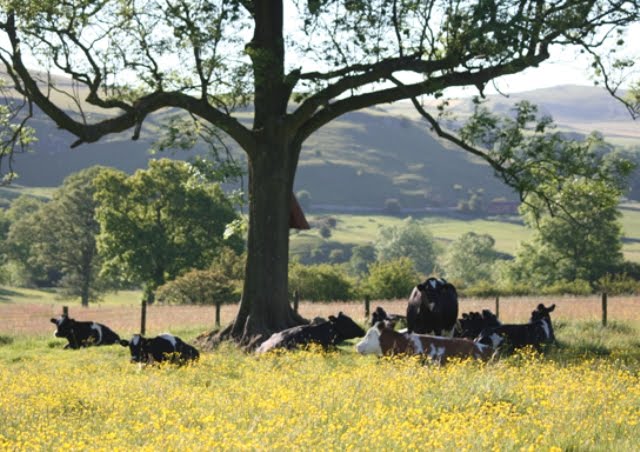 The weather has been strange this year with a very dry Spring followed by a moderate August with little very hot sunshine, but still not much rain. Our cattle are enjoying the warmth, but the traditional stone lined dew ponds on many of the upland farms are nearly dry, and as low as we have seen them for many years.


 Posts


